
Suzi
“We are only ever one bad choice away from being homeless”
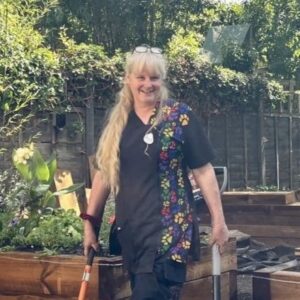
Suzi has given hundreds of hours to support some of the borough's most vulnerable people
Suzi Trusler runs her own business as a feline specialist and cat groomer. But in her free time, she gives her time to a raft of organisations connected with homelessness in Basingstoke: the Foodbank, the Night Light Winter Shelter, and The Dwelling Place, a supported house for men recovering from addiction or rough sleeping. She’s also part of a small group tending the garden at the Camrose Centre.
At the Foodbank, Suzi is a signposter at the Sarum Hill centre, meeting clients face to face and pointing them toward the support they need. At the Night Light Winter Shelter, she’s now in her third year, and works as a venue coordinator, responsible for making sure the shelter is warm, safe and welcoming, and for making sure there are always enough volunteers on site through the night. At The Dwelling Place, she helped transform an overgrown, rubble-strewn garden into a patio with raised beds and a herb garden, somewhere residents can sit and get some peace. She’s also a newly appointed trustee of Starfish Enterprise Charitable Trust an umbrella organisation assisting smaller charities who wouldn’t otherwise have the means to keep going. One of which is the Night Light Winter Shelter.
Why she started
Suzi is autistic and has ADHD. She describes a life shaped by struggles with relationships and holding down a job, which is part of why she’s self-employed. Her own children, who are also neurodivergent, went through periods of serious difficulty. The family know all too well, the vulnerabilities, fallout and consequences of traumatic early life experiences, seen through the lens of neurodivergence.
“I was completely unaware of troubles brewing”, Suzi says. “I had no experience of these things and missed all the signs”. Looking back, she says she failed to spot warning signs that might have been obvious to a neurotypical parent, and that fallout touched the whole family: estrangement, addiction, and difficulty forming healthy relationships.
It was working through her own recovery, including trauma-informed therapy, that gave her a clearer picture of what had happened, and why. She began to see her family’s experiences, and her own, through the lens of trauma rather than blame.
“Addiction is always a response, a way to try and relieve pain,” she says. “During my time at the night shelter I have witnessed this time and again.”
What she sees on shift
Night shelter volunteering runs in shifts: early evening set-up, an evening shift for food and games, two overnight shifts so there are always at least four volunteers on site, and a morning shift for breakfast and pack-down. Suzi says there’s room for anyone, whether someone can give one hour across a whole winter or far more.
She’s clear that the guests don’t fit a stereotype. “One former guest put it best: we are only ever one bad choice or bad circumstance away from being homeless.” She remembers a man who lost everything overnight despite having built a successful life, and another who was badly beaten simply for approaching the wrong people, and who she later saw rebuilding his life, “looking amazing.”
One night has stayed with her in particular: sitting with a man who struggled with severe sleep disturbance and a short temper while he talked through his life story and wept, telling her she was the first person who had ever properly listened to him.
What volunteering has given her
Suzi says the work has changed how she sees people on the street. She’s more likely now to stop, buy someone a meal, and sit with them. She talks about wanting at least one neurodivergent person on every team, for the lived experience and different way of thinking and problem-solving that brings.
She’s also been struck by how the different organisations work together, describing how even small, minority faith groups have stepped forward to cook meals for shelter guests, building relationships that help everyone feel more included.
Her message to anyone considering volunteering but not yet taking the first step: come and see what happens on an evening shift, where guests settle in, eat, and play games, before deciding whether to sign up for training.
“I volunteer because it makes a difference to people’s lives,” Suzi says, “marginalised, neglected, feeling rejected and feeling unwanted people, all searching for whatever their
purpose is, to be seen and feel loved.
“For me, volunteering gives me the opportunity to save lives, by showing love and kindness to those who otherwise would have nothing.”